Views: 0 Author: Site Editor Publish Time: 2026-03-20 Origin: Site
Selecting the right production equipment for decorative foam products often begins with one question: what exactly do you plan to produce? The answer determines which technology and workflow will support your business most effectively. A modern EPS Cornice Moulding Machine is not a single universal system. Different types are designed to meet different production goals, from simple decorative trims to complex architectural mouldings with reinforced coatings. Understanding these machine types helps manufacturers align production capacity, product design, and workflow efficiency with real market demand.
The best equipment choice depends less on technical specifications and more on the type of decorative products being manufactured. Some factories focus on standard cornice profiles produced in large volumes, while others specialize in custom architectural decorations or coated exterior mouldings ready for installation. Mapping production goals to the correct machine configuration ensures stable output, consistent quality, and scalable manufacturing.
Before evaluating equipment types, manufacturers must clarify their production objectives. Several factors determine which system configuration will work best.
Some decorative mouldings use simple geometric profiles such as straight cornices or symmetrical trims. These products are often produced in large quantities and require consistent dimensions rather than intricate detail.
Other decorative elements include relief patterns, carved textures, or curved shapes that demand more advanced cutting technologies. These designs require machines capable of flexible motion control.
Production scale is another important factor. Small workshops producing custom decorative pieces may only need moderate output capacity.
Large manufacturers serving construction projects often require continuous production lines capable of producing long runs of identical mouldings.
Understanding expected order volumes helps determine whether a basic profiling system or a more automated production line is necessary.
Some cornice products are delivered as raw foam profiles that will later receive coatings at construction sites. Others must be fully coated and reinforced during factory production.
If the final product requires protective plaster layers or polymer coatings, the production line must include coating and drying stages. These additional steps influence equipment selection.
Profiling-focused systems represent the most common starting point for decorative foam production. These machines are designed primarily for shaping foam blocks into consistent decorative profiles.
Profiling systems are particularly effective when producing standard decorative mouldings in large quantities. Straight cornices, ceiling trims, and symmetrical profiles can be produced efficiently with this equipment.
Because the cutting process follows fixed profile templates or programmed paths, each piece maintains identical dimensions. This consistency is essential for installation on building facades or interior ceilings.
Profiling systems also support long-length production, which is important for architectural applications where mouldings must extend across large surfaces.
While profiling systems are efficient, their performance depends heavily on consistent setup conditions.
Template alignment must remain accurate to ensure every piece matches the design. Wire tension and motion stability must also remain consistent to prevent edge variations.
Regular calibration ensures the system continues to produce accurate decorative profiles across extended production runs.
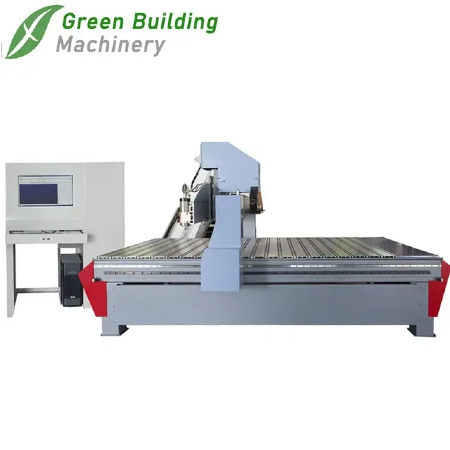
Manufacturers seeking greater design flexibility often adopt CNC-enhanced moulding machines. These systems combine foam cutting technology with programmable motion control.
CNC systems excel when producing decorative elements that include relief patterns, curved shapes, or customized designs. Architectural projects frequently require unique decorative features that cannot be produced with fixed templates.
Using digital design files, CNC machines can carve detailed foam surfaces and complex profiles.
This capability allows manufacturers to produce customized decorative mouldings for individual building projects.
One major advantage of CNC systems is flexibility. New product designs can be introduced without replacing physical templates.
Manufacturers simply load a new digital design into the control system. This capability allows businesses to expand their decorative product catalog quickly and respond to architectural trends.
For companies that serve diverse construction projects, CNC machines enable the production of both standard and custom decorative mouldings within the same facility.
Some manufacturers move beyond simple foam shaping and focus on delivering finished decorative products ready for installation. In these cases, coating-integrated production lines provide significant advantages.
Raw foam mouldings are lightweight but require protective treatment before installation. Coating systems apply specialized materials that strengthen the surface and improve durability.
These coatings protect the foam from environmental exposure and mechanical damage. Once coated, decorative mouldings can be used on exterior building facades where weather resistance is essential.
Surface coatings also enhance visual quality by providing a smooth finish suitable for painting or architectural detailing.
Coating systems require additional production stages beyond cutting. After foam shaping, mouldings move through coating equipment that applies protective layers evenly across the surface.
The products then pass through drying stages where the coating material cures and hardens.
Because coating lines integrate multiple processes, workflow stability becomes critical. Production must be carefully synchronized to maintain consistent output.
Factories producing large volumes of exterior decorative mouldings often rely on these integrated production lines to deliver installation-ready products.
Automation level represents another key difference between cornice moulding machine systems.
Semi-automatic systems require operators to perform some tasks manually, such as loading foam blocks or transferring mouldings between production stages.
These systems offer flexibility and lower initial investment costs, making them suitable for smaller factories.
Fully automatic production lines automate multiple steps including cutting, coating, drying, and handling. These systems significantly reduce labor requirements while maintaining consistent output.
Automation helps maintain stable production conditions and ensures decorative profiles remain consistent across large orders.
Automation also simplifies training for production staff. Machine control systems guide cutting paths and regulate processing parameters.
Operators primarily monitor machine performance and ensure materials move through each stage correctly.
Quality control becomes easier because automated systems maintain consistent operating conditions.
Selecting the correct production configuration requires understanding both customer expectations and internal production challenges.
Customers often notice problems related to surface finish, inconsistent shapes, or delayed delivery.
If customers frequently report mismatched decorative profiles, upgrading cutting precision may be the most effective solution.
If customers require finished products ready for installation, integrating coating systems may provide greater value.
Every manufacturing process has bottlenecks. In decorative moulding production, these bottlenecks may appear in cutting speed, coating throughput, or drying capacity.
Analyzing where delays occur helps determine which equipment upgrades will improve overall production efficiency.
Rather than upgrading the entire production line at once, many manufacturers adopt a step-by-step approach.
Adding CNC capability or coating equipment can expand product offerings while maintaining stable operations.
Gradual upgrades allow factories to increase capacity while controlling investment costs.
The following table summarizes how different cornice moulding machine types align with specific business models.
Machine Type | Best-Fit Products | Order Pattern | Main Business Benefit | Typical Upgrade Trigger |
Profiling systems | Standard cornices and trims | Large repeat orders | High-speed production | Growing order volumes |
CNC engraving systems | Decorative relief mouldings | Custom and project-based orders | Product design flexibility | Need for customized designs |
Coating-integrated lines | Exterior decorative mouldings | Continuous architectural supply | Higher product value | Demand for finished products |
Automated production lines | Large-scale decorative supply | Long-term construction projects | Labor efficiency and consistency | Rapid production expansion |
This comparison shows how equipment type directly supports different decorative product strategies.
Green building Machinery focuses on developing equipment for EPS foam processing, including cutting, recycling, and molding technologies. The company has developed a wide range of equipment such as EPS melting machines, pelletizers, foam crushing systems, and both 2D and 3D CNC cutting machines.
These technologies help manufacturers establish efficient foam processing workflows that combine shaping, recycling, and production efficiency.
In addition to equipment manufacturing, the company operates foam carving and cornice moulding production lines. This practical production experience helps improve equipment design and ensures machines perform effectively in real manufacturing environments.
With years of experience producing decorative exterior wall elements and specialized plaster formulations, the production processes have achieved consistent quality standards.
Products manufactured using these systems have been exported to markets in Europe, North America, Australia, and other international regions. This global presence reflects the increasing demand for efficient decorative foam production technologies.
Choosing the right EPS Cornice Moulding Machine is ultimately about aligning equipment with production goals. Different machine types support different product strategies, whether the focus is high-volume decorative profiles, custom architectural designs, or fully coated exterior mouldings ready for installation. By understanding how profiling systems, CNC engraving machines, coating-integrated lines, and automated production layouts function within a manufacturing workflow, companies can build production systems that support both efficiency and product quality. For manufacturers looking to scale decorative foam production, the right cornice production equipment becomes the foundation for consistent output and long-term business growth.
If your factory plans to expand decorative foam production or develop new EPS cornice products, our team can help you explore suitable equipment configurations. Green building Machinery provides advanced EPS cornice moulding systems designed to support efficient cutting, coating, and integrated production workflows. Contact us today to learn how our equipment solutions can support your decorative moulding manufacturing goals.
The most common types include profiling systems for standard decorative mouldings, CNC engraving systems for customized designs, coating-integrated production lines for finished products, and automated systems for large-scale manufacturing.
Profiling-focused systems are typically used for standard decorative cornices. They are designed to produce consistent profiles quickly and efficiently across large production runs.
Yes. CNC machines allow manufacturers to create detailed decorative mouldings using digital design files. This makes them ideal for customized architectural projects.
Coating systems strengthen foam surfaces and improve durability. Decorative mouldings with protective coatings are suitable for exterior wall installations and provide higher value finished products.