Views: 0 Author: Site Editor Publish Time: 2026-03-16 Origin: Site


Cornice orders rarely fail because there is no demand. In fact, decorative moulding is widely used in construction and renovation projects around the world. The real challenge usually appears during production, when decorative profiles from different batches fail to match perfectly. Uneven edges, slight dimensional variations, and inconsistent finishing can make installation difficult and reduce the overall appearance of a building. This is exactly where an EPS Cornice Moulding Machine becomes essential. By transforming manual foam carving into a stable production process, the machine allows manufacturers to create decorative profiles with consistent shapes, predictable quality, and reliable delivery schedules.
Cornice moulding refers to decorative trim elements installed at the intersection of walls and ceilings or along exterior facades. These decorative profiles often feature curved or detailed designs that enhance architectural aesthetics. In modern construction, many of these mouldings are produced using EPS foam because the material is lightweight, easy to shape, and suitable for coating with durable finishes.
EPS cornice products have become increasingly common in both residential and commercial construction. They provide architects and builders with a flexible solution for decorative exterior and interior designs.
Exterior wall decoration is one of the most common uses of EPS cornices. Decorative trims around windows, doors, roof edges, and balconies are frequently made from EPS foam profiles.
These decorative elements help create visual depth on building facades. Because EPS can be shaped into detailed profiles, designers have greater freedom when creating architectural patterns.
Interior decorative mouldings are also popular. Cornices installed along ceiling edges provide a refined appearance in residential spaces, hotels, offices, and commercial buildings.
Traditional decorative materials such as stone or concrete are heavy and difficult to install. EPS foam, by contrast, is extremely lightweight.
This property provides several advantages. Transportation becomes easier because large volumes of decorative profiles can be shipped without excessive weight. Installation becomes faster because workers can handle the pieces easily without special lifting equipment.
These advantages make EPS cornices attractive to contractors who want to complete projects efficiently while maintaining architectural aesthetics.
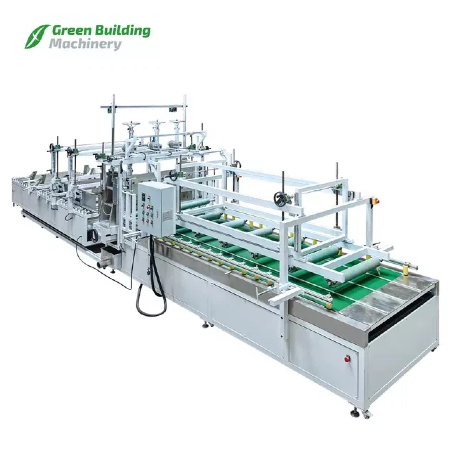
An EPS Cornice Moulding Machine is specialized equipment designed to produce decorative foam profiles used in architectural applications. Instead of shaping foam manually, the machine enables manufacturers to produce detailed mouldings with consistent dimensions and smooth surfaces.
In simple terms, the system combines foam cutting technology with production workflow integration. Foam blocks are processed through shaping, coating, and finishing stages to create decorative cornices ready for installation.
Standard foam cutting equipment can produce simple shapes, boards, or packaging inserts. However, decorative moulding production requires far greater consistency.
Cornice profiles must maintain identical curves and edges across long production runs. Even small deviations become visible once the mouldings are installed along building facades.
An EPS Cornice Moulding Machine focuses specifically on profile accuracy and repeatability. The system is designed to maintain consistent shapes while supporting efficient production workflows.
Green building Machinery focuses on developing equipment that supports multiple stages of EPS processing. In addition to cutting equipment, the company has developed EPS melting machines, pelletizers, recycling equipment, and foam molding systems.
By integrating these technologies, manufacturers can establish a more complete production environment. Foam blocks can be shaped, processed, and reused efficiently, reducing waste and improving overall manufacturing efficiency.
Manufacturers entering the decorative moulding market are often interested in understanding how a typical production line operates. A cornice moulding system usually includes several coordinated stages.
Production begins with EPS foam blocks that are shaped into decorative profiles.
Depending on the complexity of the design, machines may use two-dimensional profiling systems or CNC-controlled cutting systems. These technologies guide heated wires along precise paths to create detailed decorative shapes.
Consistent motion control ensures each piece matches the design template.
Raw foam is lightweight but requires additional surface protection before installation. Decorative mouldings are typically coated with specialized plaster or polymer materials.
This coating layer increases durability and improves the surface appearance. Once coated, the mouldings become resistant to weather and mechanical damage.
High-quality coating also allows the decorative profiles to maintain crisp edges after installation.
After coating, mouldings must be dried before they can be transported.
Proper drying ensures the surface layer hardens correctly and adheres firmly to the foam core. Once dried, the products are carefully packaged and prepared for shipment to construction sites.
Efficient handling systems reduce the risk of damage during transportation.
Many small workshops initially attempt to produce decorative mouldings using manual carving methods. While this approach can work for small projects, it becomes inefficient when demand increases.
Decorative profiles installed on buildings must align perfectly across multiple sections. If profiles vary even slightly, the difference becomes visible when installed along long architectural surfaces.
Specialized moulding machines maintain consistent shapes by following programmed cutting paths. This ensures each piece matches the original design.
Inconsistent foam shapes often lead to problems during the coating process. Uneven surfaces require additional sanding or correction before coating can be applied.
Machines that produce accurate profiles reduce the need for manual adjustments. This saves time and improves production efficiency.
Manual carving requires skilled workers who understand foam shaping techniques. Training new workers can take considerable time.
Automated moulding systems simplify the process by guiding cutting operations through machine controls. Operators focus primarily on setup and supervision rather than manual shaping.
Manufacturers often ask when it becomes necessary to invest in specialized decorative moulding equipment.
Businesses that produce cornices every week benefit significantly from automated production systems. Machines provide consistent output and allow manufacturers to handle growing orders more efficiently.
Architectural suppliers often offer multiple decorative profile designs to customers. Managing such a product catalog requires machines capable of reproducing each design accurately.
Automated systems allow manufacturers to switch between designs while maintaining consistent quality.
As order volumes increase, relying solely on manual labor becomes unsustainable. Production costs rise and delivery times become difficult to manage.
Cornice moulding machines allow companies to expand production capacity without increasing labor requirements at the same rate.
The decorative moulding production process involves several stages. Each stage benefits from reliable equipment and consistent workflows.
Production Stage | Quality Requirement | Common Bottleneck | Equipment Improvement | Output Benefit |
Foam profiling | Accurate shape and symmetry | Manual cutting errors | Precision cutting systems | Consistent decorative profiles |
Joining sections | Seam alignment | Shape variation | Stable profile production | Smooth installation |
Surface coating | Strong adhesion and smooth finish | Uneven surfaces | Accurate cutting and preparation | Better coating quality |
Drying process | Durable hardened surface | Inconsistent drying conditions | Controlled production flow | Reliable product durability |
Packaging | Protection during transport | Handling damage | Organized production output | Reduced returns |
This table highlights how specialized equipment improves multiple stages of decorative production.
Green building Machinery combines equipment manufacturing with practical experience in foam decorative production. The company operates foam carving and cornice moulding production lines, which allows continuous improvement of machine design based on real manufacturing needs.
Years of experience in exterior wall decorative products have helped develop reliable production methods and coating formulas. These solutions ensure decorative mouldings maintain both structural stability and visual quality.
Products produced using these technologies have been exported to Europe, North America, Australia, and other international markets. Global construction demand continues to drive the adoption of lightweight decorative materials such as EPS cornices.
By integrating cutting technology, coating processes, and production workflow improvements, manufacturers can deliver decorative building components that meet modern architectural standards.
An EPS Cornice Moulding Machine represents more than a foam cutting tool. It is a production system designed to create consistent decorative profiles with reliable quality and efficient workflow integration. By combining accurate shaping, durable surface treatment, and stable production processes, manufacturers can transform raw foam blocks into architectural elements ready for installation. As construction projects increasingly demand lightweight decorative materials with precise designs, advanced cornice moulding equipment provides the consistency and scalability needed to support modern decorative production.
If your business plans to produce decorative EPS cornices or expand architectural moulding production, our team can help you explore suitable equipment solutions. Green building Machinery offers advanced EPS cornice moulding systems designed for accurate profiling, efficient coating workflows, and stable production performance. Contact us today to learn how our equipment can support your decorative foam manufacturing projects.
An EPS Cornice Moulding Machine is used to produce decorative foam mouldings for architectural applications. These mouldings are commonly installed on building facades, ceilings, and exterior wall edges.
EPS foam is lightweight and easy to shape, which makes it ideal for creating complex decorative profiles. After coating with protective materials, the mouldings become durable and suitable for construction use.
Yes. After applying protective coatings such as plaster or polymer layers, EPS cornices become weather-resistant and suitable for exterior wall decoration.
Yes. Automated machines produce consistent decorative profiles and reduce the need for manual shaping. This improves production efficiency and helps manufacturers meet larger order volumes.